
Soft Tissue Balance in Knee Replacement: Measuring What Surgeons Still Judge by Feel
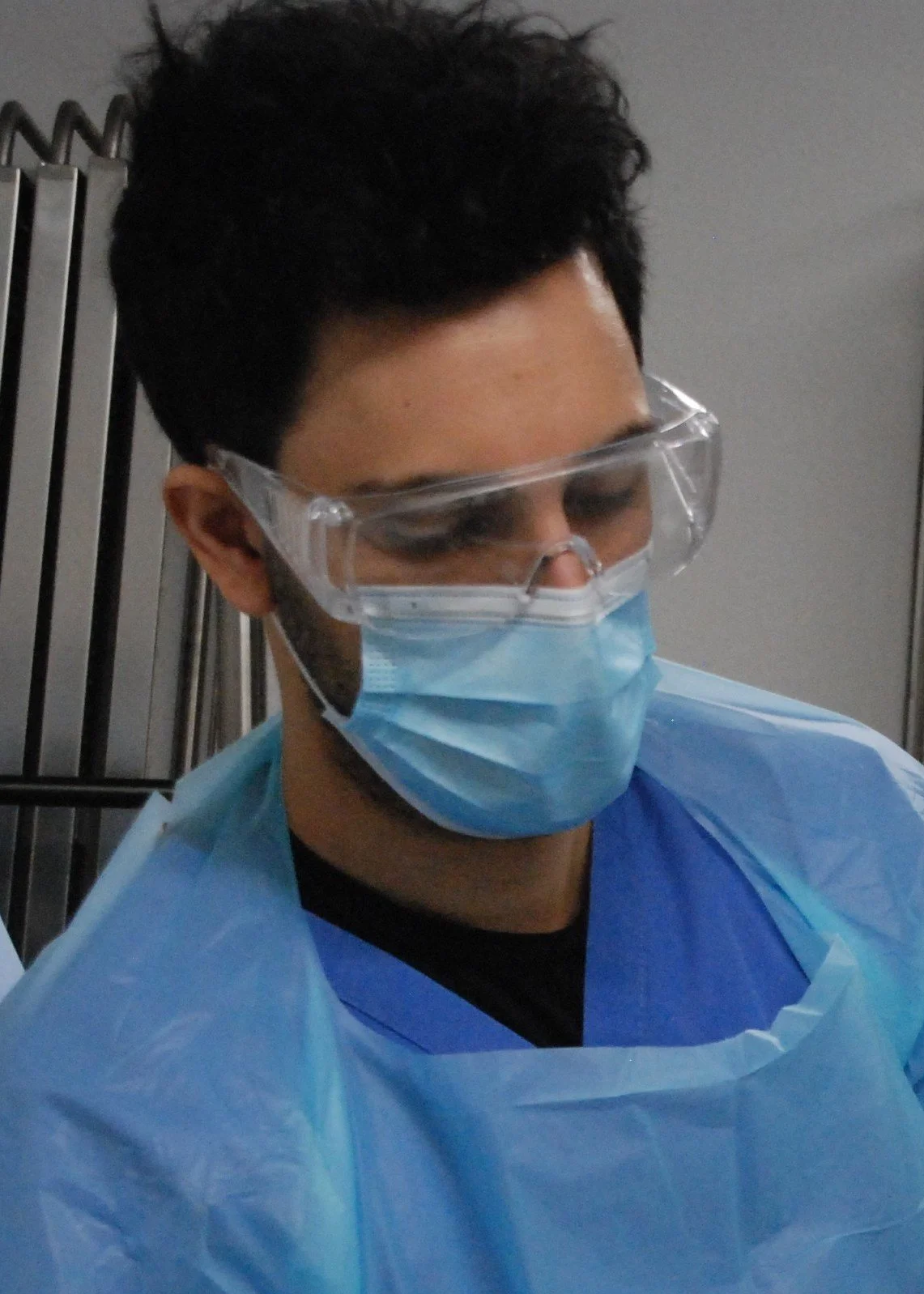
Dr Nima Razii during cadaver testing at University of Dundee, UK
Total knee replacement can be executed with high geometric precision. What remains difficult to quantify during surgery is how soft tissue adjustments influence force distribution across the joint.
Soft tissue balance is typically assessed by feel, yet small changes in ligament tension can redistribute load between the medial and lateral compartments throughout the range of motion. Measuring that force distribution during trialing makes these changes visible, allowing intraoperative decisions to be evaluated against measurable joint behavior, rather than subjective assessment.
Nima Razii is an orthopedic surgeon and honorary clinical lecturer at the University of Glasgow, with a specialist interest in knee surgery and revision arthroplasty. He is currently based at the Golden Jubilee National Hospital, where he has taken part in the cadaveric evaluation of the PPS Precision Knee Balancer (PKB), a capacitive sensor that measures total tibiofemoral force during total knee replacement, and how that force differs between the medial and lateral compartments.
"The greatest challenge for a knee surgeon is predicting outcomes," he says. Despite improvements in implant design and alignment technique, "there's still a small proportion of patients, around ten percent - and some sources quote even more - that are unhappy after a knee replacement, or not as happy as they might have expected to be," even where the x-rays look normal and no infection, loosening, or malalignment is present. The causes, he says, are "most likely multifactorial": some relate to how a patient experiences pain, others to "the surgical challenge of achieving optimum intraoperative balance."
What current technology does not capture
A conventional total knee replacement follows a familiar sequence: tibial and femoral resections, trial components inserted, the joint cycled through extension, mid-flexion, and full flexion, with the final assessment made by feel. Robotic-assisted systems have improved the accuracy of the bone cuts themselves, Razii says, but "it doesn't necessarily predict how that knee replacement is going to feel for the patient in terms of its balance." There is the bony aspect of the surgery, and there is the soft tissue aspect, and achieving the optimum balance "throughout the entire range of motion," is where practice still runs on judgement rather than measurement.
That judgement varies between surgeons, and between cases performed by the same surgeon. It cannot be reviewed afterwards or compared across a career. The forces moving through the joint during trialling stay invisible, and whether they play any part in the small proportion of patients who end up dissatisfied is, for now, a question rather than an answer.
Clinical integration as a design constraint
Workflow disruption is one of the biggest barriers to adopting new technology in orthopedic surgery, and Razii is honest in his assessment about existing robotic systems on that point. "In terms of robotic technology, there are numerous potential benefits, but there are also imaging requirements and operating theatre footprint to consider," he says. "They are currently inventory heavy and specialist setup is required for every case, although—just like other technologies, such as computers and mobile phones—they will likely evolve to become smarter, more accessible, and user-friendly in the future."
The PKB was engineered differently: a capacitive sensor built as a shim that sits between the tibial trial component and the polyethylene insert, with a small integrated display and no external cabling. "The ideal adjunct is something that fits in with your workflow seamlessly," Razii says. “Surgeons want to maintain the tempo and the cadence of an operation." A measurement system that disrupts that workflow risks limiting its own usefulness.
"It gives you a real-time reading, using actual numbers, as to the intraoperative soft tissue tension and intraoperative forces going across the medial and lateral compartments of the joint," Razii says. "To my knowledge, there hasn’t been any equivalent in day-to-day surgical practice up to now."
What the Dundee trial showed
Razii took part in a cadaveric evaluation of the PKB at the University of Dundee in 2025, working alongside colleagues from NHS Golden Jubilee and the device's developers at PPS and the University of Strathclyde. The study used the DePuy PFC Sigma knee system. "There are many different knee implants on the market," he says, "and one challenge will be engineering it in such a way that it's compatible with multiple different systems." That's a deliberate starting point, not a finished claim.
The team performed graded ligamentous and capsular releases, the same soft tissue adjustments made in any knee replacement, reading the PKB's compartment force display after each one rather than relying on feel alone. "We were amazed to see how much of an influence those soft tissue releases had on the forces that were going across the medial and lateral compartments of the knee joint," Razii says. Changes that would previously have been assessed entirely by hand were, for the first time, visible as numbers on a screen.
No target yet, and that's the honest position
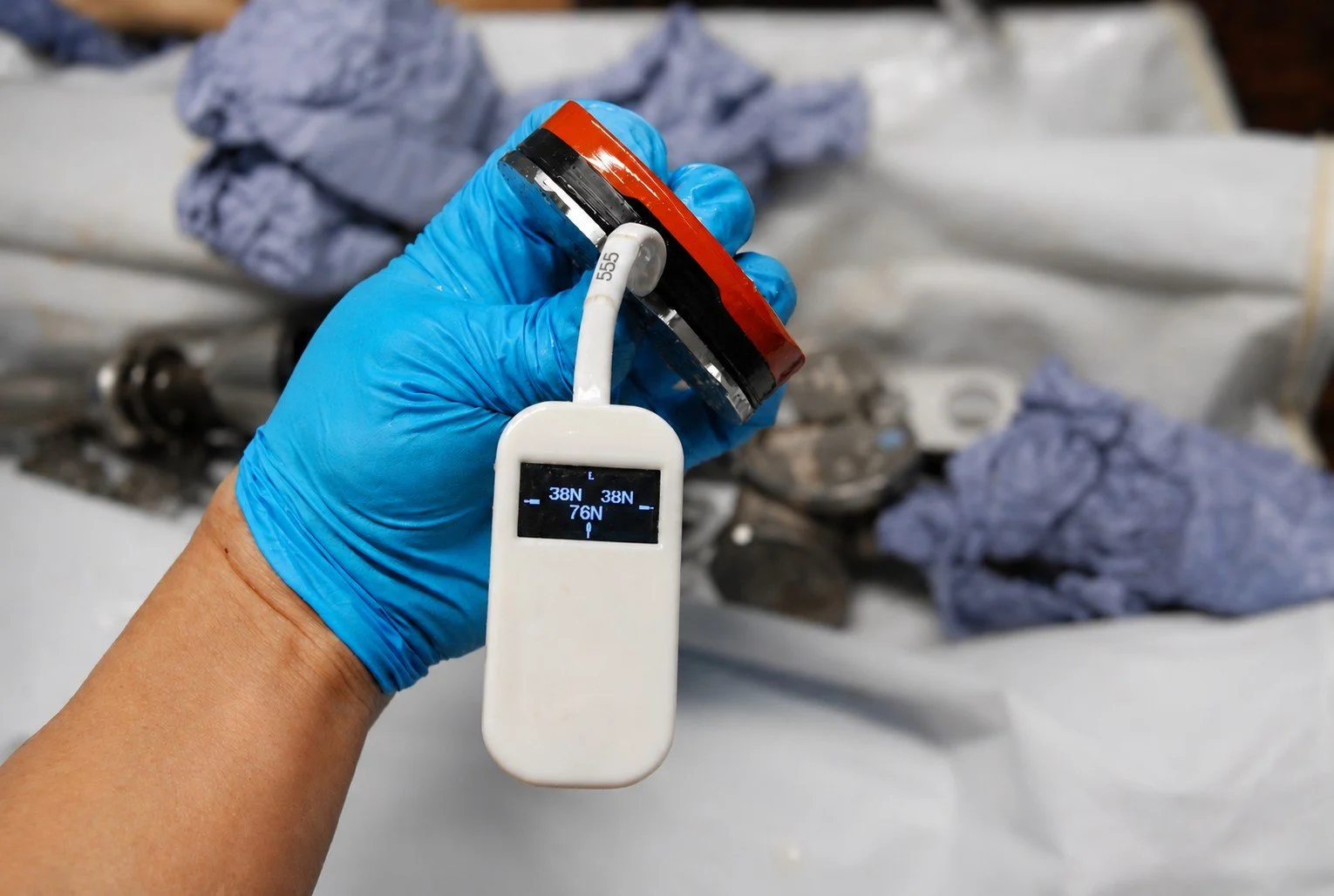
The PKB sensor during cadaveric testing at Dundee — live compartmental force readings on the display as the knee moves through flexion.
"We don't yet know what the optimum force going across each compartment of the knee joint is," Razii says. A surgeon can achieve consistent PKB readings across a series of cases, without knowing whether those readings correlate with a satisfied patient at twelve months. "That's why I think you have to start off with a tool for collecting data, and then you have to look back over time to find out which patients are satisfied, which ones are not. Once a target is clearly established, you can start working to achieve it."
He draws a parallel to the wider debate over alignment philosophies. "We don't know truly which one is the best for each specific patient," he says of the choice between kinematic, mechanical, and other alignment approaches. "We've now got evidence to say that after twenty-five years, the survivorship of knee replacements using a mechanical alignment technique is over eighty percent, but we don't know if that's certainly the best in terms of functional outcomes." Force distribution during trialing represents the same kind of question: measurable well before it is understood.
Findings from the engineering side of this work, describing the sensor itself and its validation against the DePuy PFC Sigma system, are now published in IEEE Sensors Journal (Volume 26, Issue 8, pages 12696–12703) and available open access via Strathclyde's institutional repository. Clinical follow-up, matching what the device measures against how patients actually do, is the project's next stage.
What changes for surgical training
Razii sees a training dimension to the work as well: "It potentially represents an enormously valuable training tool." A surgeon who performs fifty knee replacements and sees consistent PKB readings across most of them can provide a concrete target, "rather than a description of a feeling." Reviewed across a series of cases, those readings turn one surgeon's individual practice into something that can be discussed and taught, not just performed. Force data does not replace surgical judgement, he is careful to say, but it gives that judgement something to be checked against, for a trainee and for an experienced surgeon comparing one case with the next.
Knee arthroplasty has advanced through better implants, recognition of alignment, and navigation and robotic assistance, but soft tissue balance is still assessed largely by feel. Measuring it during trialing, without changing how the operation is performed, gives that judgement a number to work from for the first time. Whether that number eventually defines a safe zone or simply describes how much variability exists between cases, is still an open question, and one that may take years of outcome data to answer.
PPS representatives are attending the upcoming British Orthopaedic Research Society (BORS) Annual Meeting 2026 in Glasgow this September, where Alistair Lawley will present the team's latest work on the PKB.
Further reading on the device's ongoing development is available at precisionkneebalancer.com.
Do you have a medical application you would like to discuss with our engineering team?