
From a Harvard Robotics Lab to 30+ Published Studies: The History of FingerTPS
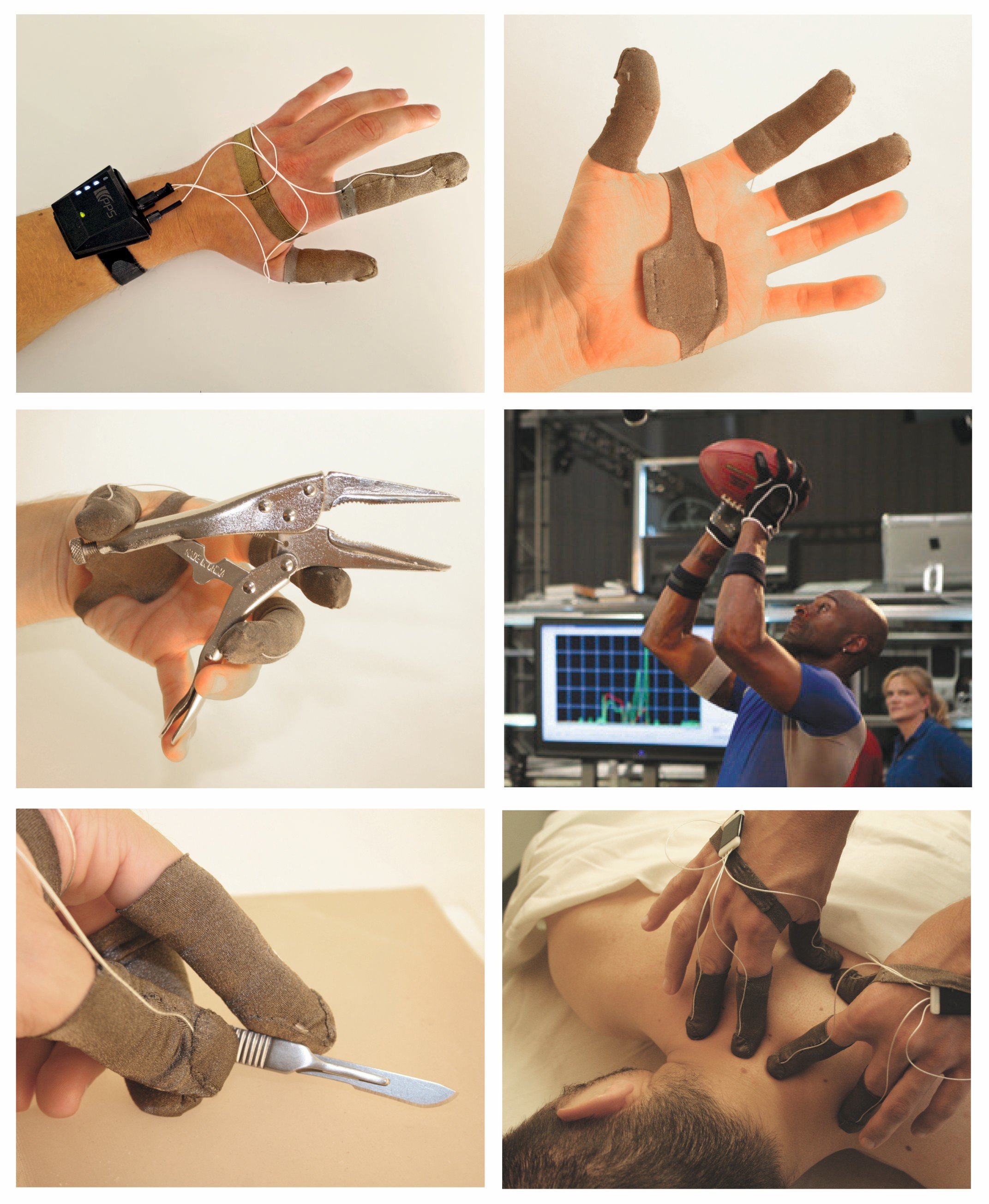
How a PhD thesis on robotic dexterity became one of the most validated wearable finger pressure sensing systems in research
Most hand research captures movement. Very few capture force. The reason is not a lack of interest but an engineering problem. Putting a pressure sensor on a human finger without changing how that finger moves, grips, or applies force to objects is harder than it sounds. If the sensor alters the task, the data reflects the alteration, not the hand.
Now imagine a sensor that slides onto a fingertip, thinner than 2mm, wireless, and calibrated in a single touch against a reference load cell. A sensor that conforms to the finger rather than constraining it, captures pressure distribution in real time, and disappears from the researcher's workflow so completely that the only thing left to study is the hand itself.
That is what FingerTPS became. This is how it got there.
The original question: what does a skilled hand actually do?
In 1996, Dr Jae Son completed his PhD at Harvard's BioRobotics Laboratory under adviser Robert D. Howe. His thesis, Integration of tactile sensing and robot hand control, addressed a problem that still drives robotics research today: how do you give a robotic finger the dexterity of a human one?
The answer required understanding what the human hand was actually doing at the point of contact with objects, not just its position or speed of movement but the forces, the pressure distribution across the sensor surface, and the mechanical parameters of a skilled grasp that separate expert performance from novice.
The tactile sensors available at the time were not capable of capturing this reliably. Piezoresistive sensors degraded over repeated use, struggled with curved surfaces, and lacked the sensitivity and durability needed for precise, repeatable data during real hand tasks in human health and robotics research. A different sensing technology was needed, and a different form factor to deliver it.
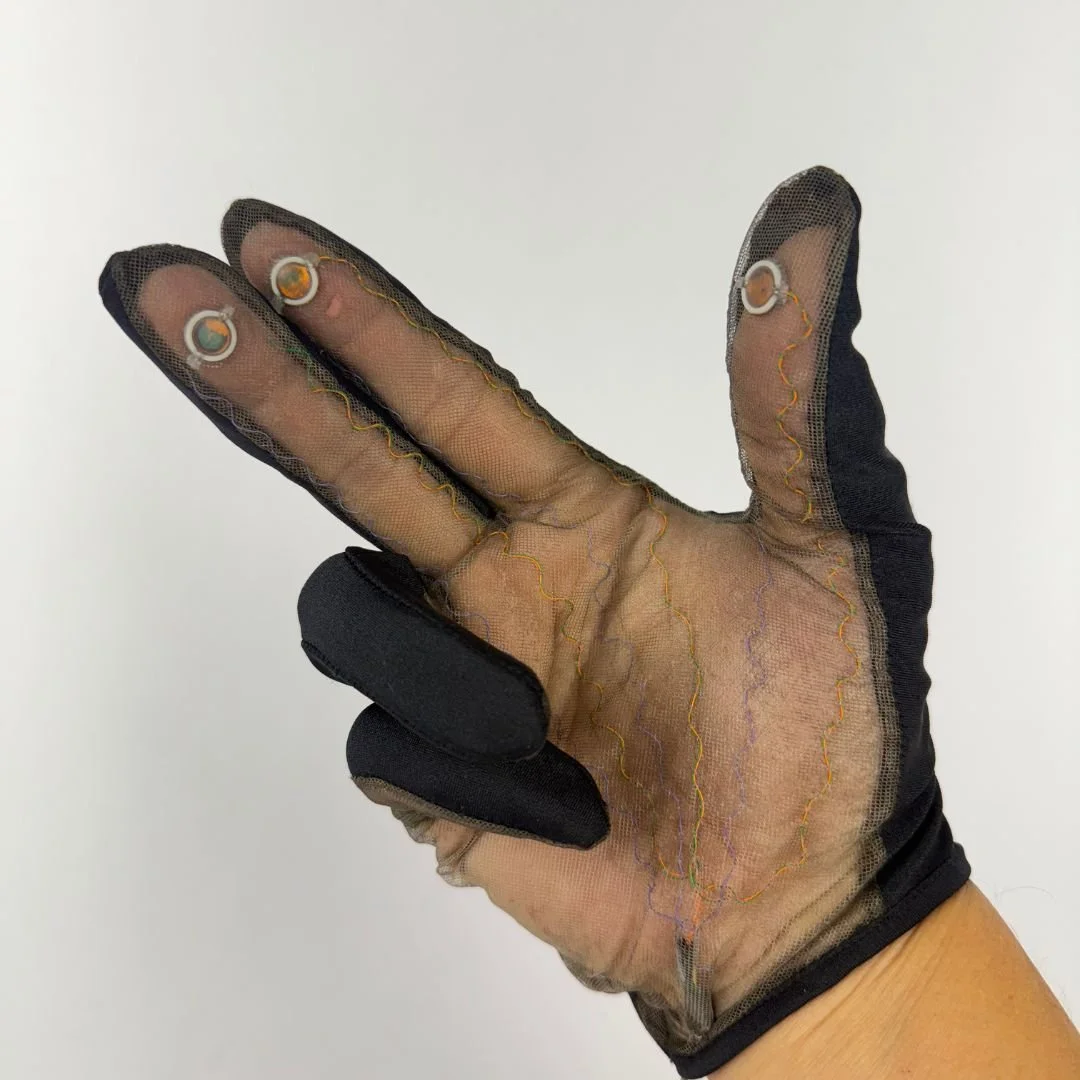
The early DARPA-funded finger sensing system that preceded FingerTPS - capacitive sensors embedded in a net glove, developed to capture fingertip forces during surgical simulation research in the late 1990s.
DARPA and the surgical simulation challenge
Following his PhD, Dr Son secured research funding from DARPA, the Army Research Laboratory, and the National Institutes of Health. The challenge was specific: quantify what expert surgeons do with their hands precisely enough to build virtual surgical training simulators capable of actually teaching the skill.
The movements of a surgeon were already observable. What was not observable was the force behind them: the pressure each finger applied during interaction with surgical simulator controls, the distribution across fingertips during a grasping task, the parameters that distinguish the technique of an experienced hand from a novice one.
The early system used a net glove with three fingertip sensors to capture these forces during computer mouse and simulator use, generating the kind of contact data that no camera or motion capture system could determine. Measuring this without altering the technique being studied became the central engineering problem that would define FingerTPS for the next thirty years.
From research to commercial system
In 1996 PPS was established in Los Angeles to continue that research through commercial development. Early collaborations with MIT on robotics, the Army Research Lab on ruggedised sensors, NIH on medical applications, and Kimberly Clark consumer product partners imposed their own requirements on what the sensing system needed to address: sensor conformability, signal reliability under repeated loading, and calibration simple enough for a non-specialist in the field. Each project refined the components and pushed the system closer to something deployable outside a government research environment.
The first commercial FingerTPS launched in 2006 as a wired USB research kit: high performance capacitive pressure sensors integrated into stretchable fabric worn on the fingertip, with wires running from the fingertip sensors to a wrist module and then to a computer. It worked. Researchers could measure pressure distribution across individual fingers during natural hand tasks, capturing force data that no motion capture system could determine.
But anyone who has tried to study natural hand movement while managing cables from fingertip to wrist to belt to computer understands the limitation: every cable is a constraint and every connection point introduces a variable. The next step was clear.
An early FingerTPS demonstration - the system and Chameleon software shown at a trade event shortly after the commercial launch
Going wireless
Removing the cable between the system and the computer was not a convenience improvement but an engineering decision about measurement integrity. A tethered system introduces resistance at the wrist, changes the weight distribution of the hand, and limits the tasks that can be studied naturally.
When the wireless Bluetooth version of FingerTPS was unveiled in Tokyo in 2008, researchers could for the first time measure finger forces during unconstrained movement, with pressure distribution data transmitting wirelessly at up to 40 Hz. That same year FingerTPS featured on FSN's Sport Science measuring the fingertip forces of NFL receiver Jerry Rice and NBA sharpshooter Jason Kapono, and on National Geographic Channel's FightScience with MMA champion Randy Couture, demonstrating that a system built for a surgical simulation lab could perform reliably in an uncontrolled environment.
Solving the fit problem
Wireless transmission addressed the cable problem, but field use revealed the next factor: fit. A capacitive tactile sensor reads accurately only when it is in precise contact with the surface being measured. If the sensor material does not conform to the finger, or if the sizing is wrong, the data reflects the fit of the device rather than the force of the finger. For a research-grade measurement system, that is not a comfort issue but a data quality issue.
FingerTPS II launched in 2011 with new Lycra sensor materials that conformed more naturally to varying finger geometry and maintained consistent contact during dynamic tasks. A sizing system from XS to L ensured that the sensor sat correctly regardless of hand dimensions, and a refined one-touch calibration process removed operator variability from setup.
The result was a system where the data reflected what the finger was doing, not the fit of the device measuring it. The same engineering principles carried directly into the TactileGlove, the full-hand pressure mapping system PPS developed for applications requiring whole-hand pressure distribution rather than individual fingertip measurement.
What 30+ published studies look like in practice
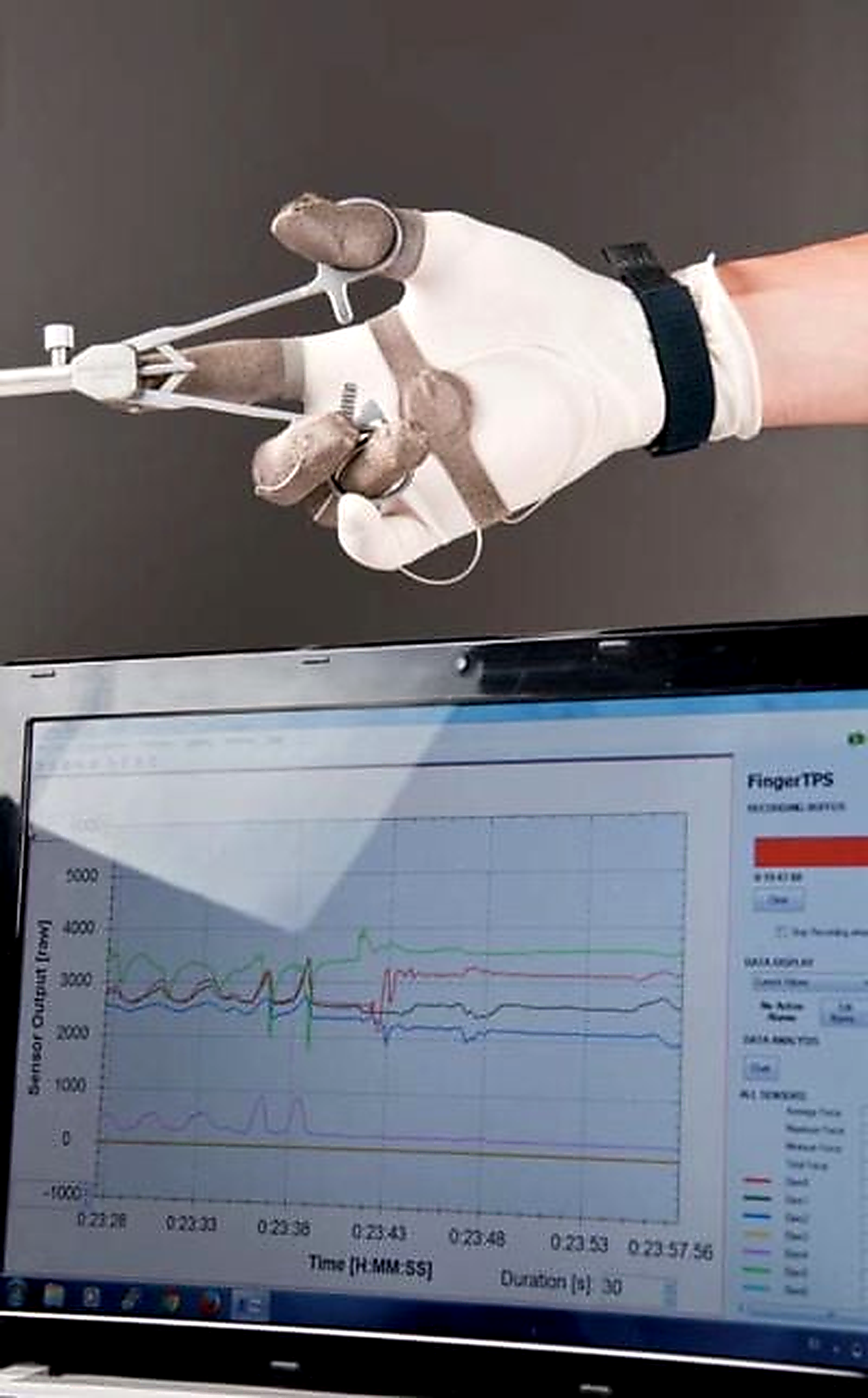
Since 2010, independent researchers have chosen FingerTPS for finger tactile pressure sensing research across fields that reflect how broadly the core engineering problem turns out to matter:
Surgical skills: laparoscopic technique, microsurgical anastomosis, cannulation assessment, and neonatal CPR
Ergonomics: colonoscopy hand forces, milling machine grip parameters, and manufacturing process task loads linked to musculoskeletal disorders
Rehabilitation: finger forces in hand arthritis and hand exoskeleton benchmarking
Robotics: detecting the direction and magnitude of contact forces for training dexterous robotic finger manipulation systems, connecting tactile sensing integration directly to current manipulation research
Sports science: grip pressure in baseball, fingertip contact in basketball, and hand forces in golf
A 2020 study in the Journal of Electromyography and Kinesiology noted that FingerTPS reduces interference with natural hand motion by integrating capacitive sensing elements into microspandex material. That is the same design principle the system was built on: measure what the hand does without changing how it does it.
The frontier of fine dexterous measurement
The most demanding current application of FingerTPS is the work Evelyne Boulay has led at Edwards Lifesciences. As Director of Environmental Health and Safety, she used FingerTPS to quantify ergonomic risk for employees manufacturing medical heart valves by hand, under microscope, where a millimetre difference determines whether a product is approved or rejected.
FingerTPS was chosen for the same reason it was built: subtle enough to wear under a standard cleanroom glove without altering the task. Force data captured in real time, synchronised with posture and movement tracking, travelled far beyond the ergonomics team — into R&D, supply chain, and senior VP meetings.
By 2024, Edwards had built their own AI ergonomic risk assessment tool incorporating that data, which won an Ergo Cup Award in 2026 for reducing worker’s injury by 48%.
From Harvard to heart valves
Thirty years after Dr. Jae set out to measure what a skilled hand actually does at the point of contact, FingerTPS is part of the daily workflow at one of the world's leading medical device companies, not in a research simulator, but in the hands of the people whose long-term health depends on what the data shows.
Explore further
→ Browse published research — Published studies
→ Ready to discuss your application — Contact PPS
→ Watch the full webinar — Quantifying Fine Dexterous Tasks